The A-Z of Effective, Inclusive Campaigns
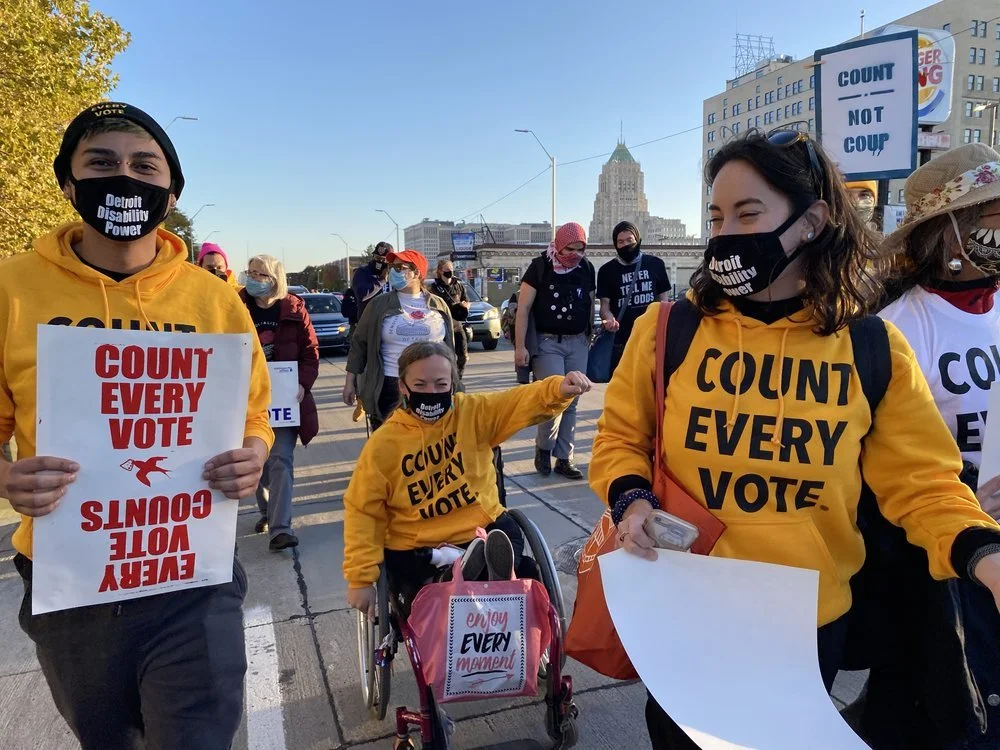
Photo by Teddy Dorsette III: Three people wearing bright orange hoodies that say "Count Every Vote" march in a protest. One is holding a "count every vote" sign. Another raises a fist from her wheelchair. They are wearing masks that say Detroit Disability Power.
Who is The A-Z of Effective, Inclusive Campaigns for?
Small organizations and groups without prior campaign experience will benefit from a comprehensive outline of what is needed to run a voter engagement campaign.
Organizations with lots of campaign experience but limited knowledge of disability rights will benefit from a single, organized source of information on how to integrate disabled people into every aspect of their work.
What’s in the Inclusive Campaign Guide?
Fundamentals of Disabilities and Campaigning provides essential background on how to understand disabilities and put best practices in place in your campaign. Campaigns must move away from a toxic tradition of exclusionary practices.
Campaign Planning and Resources
Inclusive Message Development and Delivery moves from general principles to specific recommendations. This content will be most valuable for people new to campaigning, but veterans will benefit from advice on how to adapt basic campaign components for disabled participants and audiences.
Fostering Effective, Inclusive Campaign Teams is intended to help you achieve optimal performance while running your campaign with values of dignity and respect for all team members. The framework offered here is a vital intersectional tool for everyone running a campaign.
Deploying Your Campaign Team for Voter Engagement addresses the heart of the electoral campaign: direct voter contact.
Access to Voting Itself focuses on the culmination of every electoral effort: enabling as many people as possible to vote.
Disability Resources and How-To is technical guidance referenced throughout the guide. If you are committed to disability inclusion, ensure all activities and communications follow this technical guidance.
Sample campaign materials
Glossary
The A-Z of Effective, Inclusive Campaigns: Win Elections by Getting Out the Disability Vote provides guidance to people running electoral campaigns so that they mobilize disabled people more effectively as voters, volunteers, paid staff and core leaders.
Voters with disabilities represent an untapped resource for many electoral campaigns, so improving outreach to them can enable campaigns to swing elections. Electoral campaigns need more capacity and more skills, so they benefit when disabled people can contribute their talents and perspectives.
“It is essential that we center disability justice both as a policy priority and as an approach to the way we organize and mobilize voters.
The disability community in America has faced systemic disenfranchisement, from unconscionable barriers to healthcare to income limits for those seeking accessible housing to barriers to marriage. And yet, and still – in the face of disenfranchisement – the disability community has activated, organized, and fought for progress.
This guide is a phenomenal resource. I encourage every candidate who seeks to mobilize a diverse and intersectional coalition of voters to incorporate these principles and tips into the infrastructure of their campaign.
We all have notes to take and lessons to learn here.
”
-
Alexa Borromeo (she/her) is a Filipina multimedia artist, community organizer, and experienced DE&I facilitator. Alexa is Founder & Principal Consultant for Alexa Borromeo Creative & Community Consulting and she also serves as Communications Officer at the Skillman Foundation. Before that, she led Focus: HOPE’s Generation of Promise Program, a social justice and youth leadership program serving 15 Metro Detroit high schools. At Focus: HOPE, she also provided customized DE&I training and facilitation and creative services in corporate and non-profit sectors across Southeast Michigan.
Tory Cross (she/her) is a disabled queer survivor, organizer, and disability advocate. Tory graduated with her Masters of Science in Public Health in 2017 from Johns Hopkins, where she focused on public health policy and poverty. Her past work includes policy research and analysis, advocacy, and staffing progressive campaigns, including providing accessibility guidance and advising on disability policy. She currently serves as the Senior Policy & Legislative Lead at Be a Hero, the health care justice organization founded by Ady Barkan.
Sara Fisch (she/her) is a disabled organizer from New York with a passion for making every community more accessible. As Co-Director of Neighborhood Access, she collaborates with political campaigns, social justice organizations, small businesses and large companies to make their content and practices more accessible to the disabled community. She was an Organizing Fellow, GOTV Organizer, and Disability Policy Advisor on Mondaire Jones’ congressional primary campaign and was a Field Organizer on the Iowa Democratic Party’s Coordinated Campaign for the general election. Most recently, she advised on Rebecca Lamorte’s New York City Council campaign while finishing her Associates in Human Development at Penn State University.
Jules Good (they/them) is a multiply-disabled disability justice activist. They are the Founder and Consulting Lead at Neighborhood Access, which works with organizations to help them make their presence, processes, and practices accessible to the disabled community. They are passionate about making civic engagement accessible and playing a part in creating a democracy where the most marginalized perspectives are taken into account. Jules holds their Master in Public Policy from the University of New Hampshire.
Jasahn M. Larsosa is a community and social justice organizer, business and DEI strategist, and nonprofit leader serving currently as Founding Director of Advocacy, Equity, & Community Empowerment for the Detroit-based and nationally renowned civil rights and human services organization Focus: HOPE. He’s a co-Principal Investigator for Community-Based Participatory Research projects addressing mass incarceration, economic justice, and mental wellness. He’s co-owner of the community and economic development firm Black America Rising. He lives in Detroit with his wife Krystal Larsosa and their three brilliant and beautiful Black daughters known collectively as the HerSheKissis.
Tova Perlmutter (she/her), Special Projects Consultant at Detroit Disability Power (DDP), has over 30 years of experience helping progressive initiatives obtain and use resources to advance social change. In 2020, she managed DDP’s get-out-the-vote campaign, leading a diverse team of 11 who reached over a quarter of a million voters in Southeast Michigan. Before that, she was part of the leadership team at nonprofit media outlet Mondoweiss.net and served as Executive Director of the Sugar Law Center for Economic and Social Justice, a Detroit-based national nonprofit dedicated to advancing the rights of working people and their communities. Tova’s work with DDP has been healing and awakening, as she has learned to recognize and draw on her own experience as a disabled person.
Eric Welsby is an activist, educator, entrepreneur and nonprofit manager. He has provided project management and strategic planning support to a number of organizations, including the Michigan AFL-CIO and numerous political and lobbying campaigns. He operates his own political consulting business and serves as Project Manager for Advocacy, Equity & Community Empowerment at Focus: HOPE. Welsby has taught at Saginaw Valley State University and Delta College. He has expertise as a trainer, facilitator, content expert and consultant, on topics including government, politics, DE&I and strategic planning.